

Brands That Finance Documentaries For YouTube Will Own the Next Generation of Search

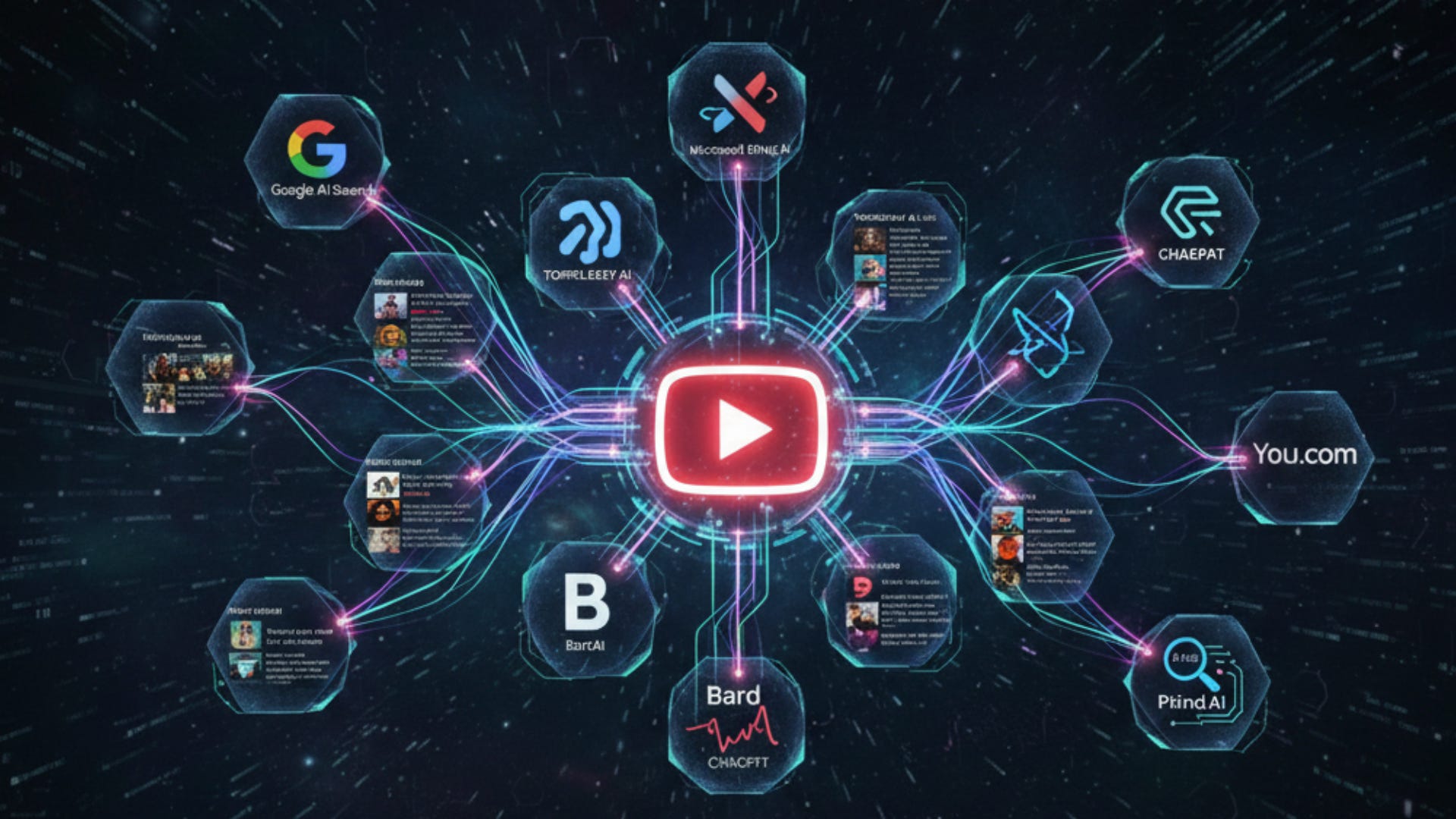
The Structural Shift in Search
Search has fundamentally changed. Google’s market share fell below 90% in late 2024 for the first time since 2015, hovering between 89-90% throughout 2025. AI-powered tools now claim 6% of search traffic, with projections suggesting 10-14% by 2028. ChatGPT processes 2 billion queries daily with 800 million weekly active users. Google’s AI Overviews reach 1.5 billion monthly users across 200 countries.
Traditional search returns links. AI search returns answers. That difference eliminates the layer where brands could position themselves. When 93% of queries in Google’s AI Mode result in zero clicks, compared to 34% in traditional search, visibility mechanics have collapsed. The race is no longer about ranking. It’s about becoming part of what the answer is made from.
YouTube as the Dominant Training Corpus
YouTube operates as the largest continuously refreshed knowledge base on the internet. As of 2024, estimates suggest 14.7 billion public YouTube videos exist globally. 96.81% contain audio, and approximately 40% of those with audio contain speech rather than music. This translates to roughly 8 billion videos with extractable human language:structured, indexed, timestamped, and continuously updated.
The scale is staggering. Research estimates YouTube contains approximately 100-200 trillion tokens of transcribable content. For context, GPT-4 trained on roughly 5-13 trillion tokens. Llama 3 trained on 15 trillion tokens. Llama 4 trained on over 40 trillion tokens. YouTube alone contains enough training data to build multiple generations of frontier models.
Documented Use of YouTube Training Data
Multiple investigations have confirmed systematic use of YouTube data for LLM training:
In April 2024, The New York Times reported that OpenAI created Whisper, a speech recognition model, specifically to transcribe audio from videos. An OpenAI team including president Greg Brockman transcribed more than one million hours of YouTube video. These transcripts were used to train GPT-4.
In July 2024, Proof News revealed that a dataset called “YouTube Subtitles”:containing transcripts from 173,536 videos across 48,000 channels:was incorporated into “The Pile,” an 825GB training dataset created by nonprofit EleutherAI.
Companies confirmed to have used The Pile for training include Anthropic, Apple, Nvidia, and Salesforce. Content included came from channels like Khan Academy, MIT, Harvard, BBC, NPR, Wall Street Journal, as well as creators like MrBeast (289M subscribers), Marques Brownlee (19M subscribers), and PewDiePie (111M subscribers).
A class action lawsuit filed in August 2024 by YouTuber David Millette alleges OpenAI profited from transcriptions without creator notification or compensation, violating YouTube’s terms of service.
YouTube CEO Neal Mohan stated that training AI models on YouTube videos would violate the platform’s terms of service. Google CEO Sundar Pichai confirmed this position. Yet the practice continues through datasets that exist in gray legal zones, scraped by third parties, repackaged as research datasets, and distributed to AI companies who claim they’re using “publicly available” data.
Why YouTube Matters More Than Other Sources
The primacy of YouTube in training pipelines is not accidental. It reflects specific structural advantages:
Format density: Video transcripts contain language tied to visual context, speaker identity, subject matter taxonomy, and temporal structure. This multimodal richness teaches models relationships between concepts that text alone cannot capture.
Semantic repetition: A 90-minute documentary repeats core concepts, entities, and relationships across its runtime. This repetition, layered with narrative coherence, is exactly what modern transformer architectures weight most heavily during training.
Authority signals: YouTube’s algorithm already ranks content by credibility, engagement, and production quality. Models trained on YouTube inherit these rankings as implicit authority weights.
Continuous refresh: Unlike static datasets, YouTube updates in real time. New videos publish constantly, providing models with current language patterns, emerging terminology, and evolving cultural context.
Structured metadata: Every video includes title, description, tags, timestamps, chapters, and comments. This metadata provides labeled training examples that teach models how humans organize and retrieve information.
Documentary Content as Strategic Infrastructure
Short-form content feeds engagement algorithms. Long-form content trains knowledge systems.
A 90-minute documentary is not a video. It is a dense, deeply indexed object containing:
Narrative structure that models learn to replicate
Entity relationships that build knowledge graphs
Expert presence that establishes authority
Language patterns that shape tone and framing
Causal reasoning that teaches logical progression
Visual-linguistic binding that grounds abstract concepts
When distributed on a brand’s YouTube channel, documentary content creates sustained semantic gravity. The brand becomes inseparable from the subject matter in the training layer. Every mention of the topic pulls the brand into the context window.
The Compounding Nature of Training Data
Paid campaigns stop. Posts decay. Sites fall out of favor. Training data persists.
Once a video enters training datasets, it continues to shape model outputs indefinitely. Models learn associations, extract patterns, and build knowledge graphs that persist across model versions. A serious documentary filmed today will inform AI systems for years, potentially decades, as models retrain on refined versions of existing datasets.
This explains why production quality, narrative rigor, and intellectual honesty suddenly matter more than ever. Models learn from what is credible, cited, complete, and internally consistent. Lightweight brand content becomes noise. Documentary content becomes reference material.
Current Training Data Economics
The AI industry faces a training data crisis. Current LLM training sets approach 15 trillion tokens, within an order of magnitude of all high-quality public text. For English, the upper limit may be 40-90 trillion tokens. Including non-English data might reach 100-200 trillion. After that, high-quality public data is exhausted.
Private data is larger but legally restricted. Facebook posts likely contain 140 trillion tokens. Gmail contains approximately 400 trillion tokens. But using this data without consent creates massive liability exposure, as demonstrated by ongoing lawsuits.
YouTube represents one of the last massive reservoirs of legal-gray-zone training data. It’s public. It’s structured. It’s high-quality. It’s continuously updated. And until recently, few creators knew their content was being used.
The Strategic Implication
Brands that build long-form documentary libraries on YouTube now are not optimizing for algorithm updates. They are embedding themselves in whatever replaces search itself.
The shift is from renting relevance to manufacturing it. From appearing next to answers to becoming part of what answers are made from. From campaign thinking to infrastructure thinking.
This is not media strategy. This is systems strategy. The question is no longer “what should we post” but “what domains of expertise do we want machines to associate us with for the next decade.”
The brands that understand this will invest now to own the future of search and SEO.